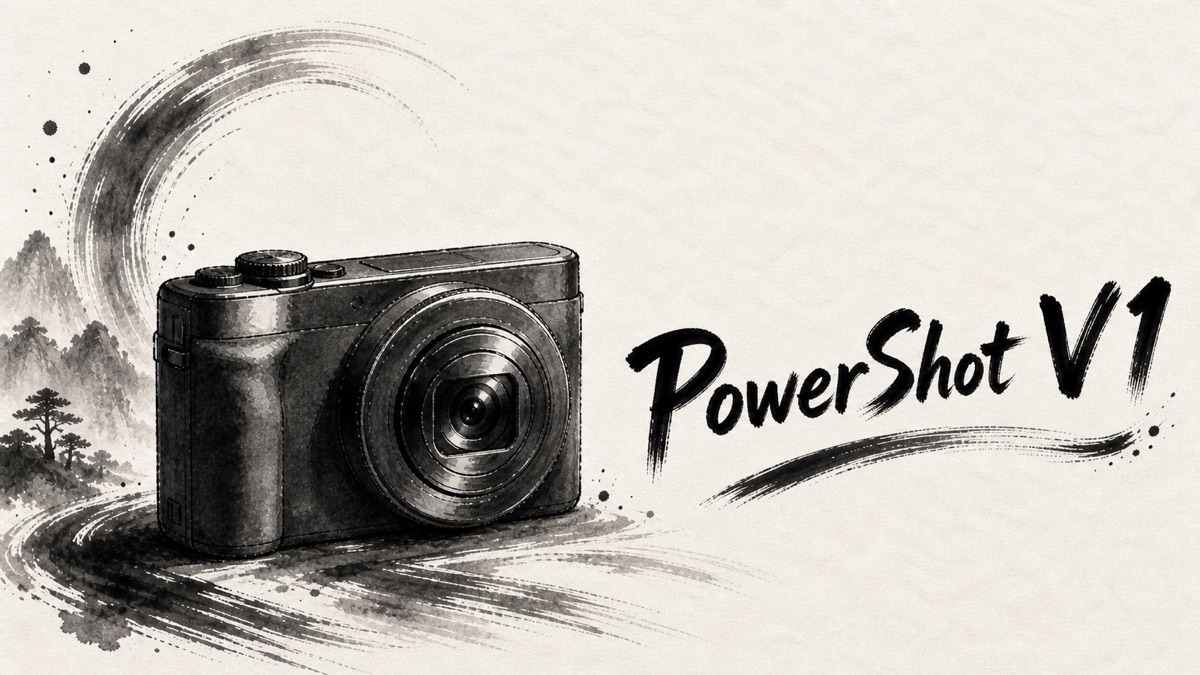
You may be considering the Canon PowerShot V1 because you want a compact camera that can handle both still photos and video better than a smartphone, without moving all the way into a full interchangeable-lens setup.
Japanese user feedback suggests that this camera is being judged less as a tiny pocket compact and more as a serious hybrid camera in a compact body. The strongest praise tends to focus on image quality, wide-angle shooting, autofocus, video usefulness, and everyday versatility.
At the same time, users also point out practical compromises: the body is larger and thicker than some people expect, zoom reach is limited, stabilization is not action-camera-like, and some accessories or charging expectations may need checking before purchase.
Amazon.com
Canon PowerShot V1
Check current availability on Amazon.com
As an Amazon Associate I earn from qualifying purchases.
What’s Canon PowerShot V1
Canon PowerShot V1 is a compact hybrid camera for users who want stronger photo and video results than a smartphone without moving into a full interchangeable-lens system. Japanese feedback tends to judge it as a small serious camera rather than as a tiny pocket compact.
The main appeal is the combination of image quality, Canon-like color, wide-angle usefulness, autofocus, and video flexibility in one fixed-lens body. That makes it relevant for travel, family use, snapshots, Vlog clips, and everyday photo-video shooting.
The trade-off is physical and practical: it is thicker than some compact-camera buyers expect, zoom reach is limited, stabilization has limits, and accessories or charging expectations may need checking before purchase.
Positive Reviews
Positive feedback focuses on users who wanted a compact camera that feels meaningfully better than a smartphone while staying simpler than a lens system.
- Strong image quality. Users often describe still photos as clearly better than older compact cameras or smartphones.
- Good color and Canon-like rendering. Several impressions highlight pleasing color rather than only sharpness.
- Useful for both photos and video. The camera is often treated as a hybrid tool rather than a stills-only compact.
- Wide-angle shooting is practical. Users appreciate the wide end for travel, family scenes, indoor use, and video.
- Autofocus feels fast. Visible reviews mention quick focusing and easy everyday shooting.
- Compact compared with a full camera setup. Even when users call it large for a compact camera, they still see it as smaller than carrying a larger system.
- Grip and hold can feel better than expected. The thicker body appears to help some users hold it securely.
- Good travel and daily snapshot fit. Several users describe it as a camera they can take out more casually than a larger camera.
- Video features add value. Users mention Vlog-style use, slow-motion or video shooting, and general video convenience.
- Overall satisfaction is high. The checked Japanese feedback was broadly positive, with most visible ratings in the 4- to 5-star range.
Negative Reviews
Critical feedback centers on the fact that the PowerShot V1 is compact, but not tiny, and that its hybrid design still has category limits.
- It is not truly pocket-size. Users repeatedly mention that it is bigger, thicker, or heavier than expected for a compact camera.
- Zoom reach may feel short. Some users wanted more reach on the telephoto end.
- Stabilization has limits. It may be fine for careful handheld use, but it is not a replacement for an action camera or gimbal in movement-heavy video.
- Zoom operation in video can feel too quick. At least one user found zooming during video less smooth than expected.
- Button and dial layout may not suit every hand. Handling is generally liked, but the control layout is a recurring caveat.
- Battery charging expectations need checking. Users mention that a separate charger or cable situation may disappoint buyers who expect more included accessories.
- Accessory compatibility can be annoying. Existing flashes, cases, or other accessories may require adapters or separate purchases.
- Wide-angle image edges may not satisfy everyone. A user noted that the edges can look weaker in some wide-angle scenes.
- It is not a direct replacement for very slim premium compacts. Buyers comparing it with thinner fixed-lens compacts may find the body too thick.
Product Review Summary
Design
Body design and portability are central because buyers often compare the V1 with both smartphones and slimmer compact cameras.
Pros
- Smaller than carrying a larger camera system.
- Grip and thickness can make it easier to hold securely.
- The design supports both still photos and video use.
Cons
- Larger and thicker than many people expect from a compact camera.
- It may not disappear into a pocket like slimmer premium compacts.
The design works best if you think of it as a compact hybrid camera, not as the smallest possible pocket camera.
Image Quality
Photo quality is where the V1 most clearly justifies being carried separately from a phone.
Pros
- Image quality is one of the strongest praised areas.
- Users describe a clear improvement over older compacts and smartphones.
- Color, detail, and still-photo satisfaction are frequently positive.
Cons
- Wide-angle edge quality may matter for some scenes.
- If you already carry a larger camera system, expectations should be calibrated.
The PowerShot V1 appears strongest for buyers who want a visible image-quality step up without carrying interchangeable lenses.
Video
Video usefulness is a major reason Japanese users treat the V1 as more than a still-photo compact.
Pros
- Users see it as useful for Vlog-style and everyday video.
- The wide angle helps with video framing.
- It can handle both photos and video in one body.
Cons
- Stabilization is not action-camera-like for heavy movement.
- Zooming while recording may feel too fast or less smooth to some users.
The camera is best for controlled handheld video, family clips, travel footage, tabletop recording, and casual Vlog use rather than aggressive action footage.
Handling & Controls
Autofocus and handling shape whether the camera feels easy enough for daily use.
Pros
- Autofocus speed receives positive comments.
- The grip feels better than expected to some users.
- Everyday shooting can feel quick and convenient.
Cons
- Button and dial placement may not fit every user.
- Some software or zoom settings may feel like they need refinement.
Handling is generally positive, but buyers who are picky about controls should try it in person if possible.
Portability & Accessories
Real-world carry depends on accepting the body thickness and checking accessories before buying.
Pros
- Easier to carry than a larger camera kit.
- Suitable for travel and daily snapshots.
- The zoom lens gives more flexibility than a fixed-lens compact.
Cons
- Body thickness is a common caution.
- A charger, cable, case, flash adapter, or other accessories may need separate checking.
Portability is good in a “small serious camera” sense, but not in a “tiny pocket camera” sense.
Value
Value depends on wanting one compact Canon camera for both photos and video.
Pros
- Strong fit for users who want better image quality, wide-angle shooting, and video in one compact body.
- Good alternative to carrying a larger camera system for casual use.
- Japanese user satisfaction looks broadly positive in the checked reviews.
Cons
- Buyers should compare it with smartphones, action cameras, slim compacts, and mirrorless cameras depending on their main use.
- If portability or stabilization is the top priority, another category may fit better.
The value is strongest when you specifically want one compact Canon camera for photos and video, and you accept that the body is not ultra-small.
Amazon.com
Canon PowerShot V1
Check current availability on Amazon.com
As an Amazon Associate I earn from qualifying purchases.
Summary
Canon PowerShot V1 suits users who want a compact hybrid camera with strong image quality, useful wide-angle shooting, fast autofocus, and better photo-video flexibility than a smartphone.
It is recommended for:
- Travelers who want better image quality without a full camera kit.
- Family users who shoot both photos and video.
- Vlog users who mostly record controlled handheld or fixed-position footage.
- Smartphone users who want a clear image-quality step up.
- Canon users who wanted a modern PowerShot-style compact.
It may not be the best choice for:
- Buyers who want the smallest possible pocket camera.
- Users who need long telephoto reach.
- People who want action-camera-level stabilization.
- Anyone who expects every accessory, charger, or cable to be included.
- Buyers comparing it directly with very slim premium compacts.
Overall, Canon PowerShot V1 looks well received in Japanese user feedback, especially for image quality, color, autofocus, wide-angle usefulness, and hybrid photo-video flexibility. Its cautions are practical rather than fatal: it is thicker than many expect, zoom reach and stabilization have limits, and accessories should be checked before buying.
Comments