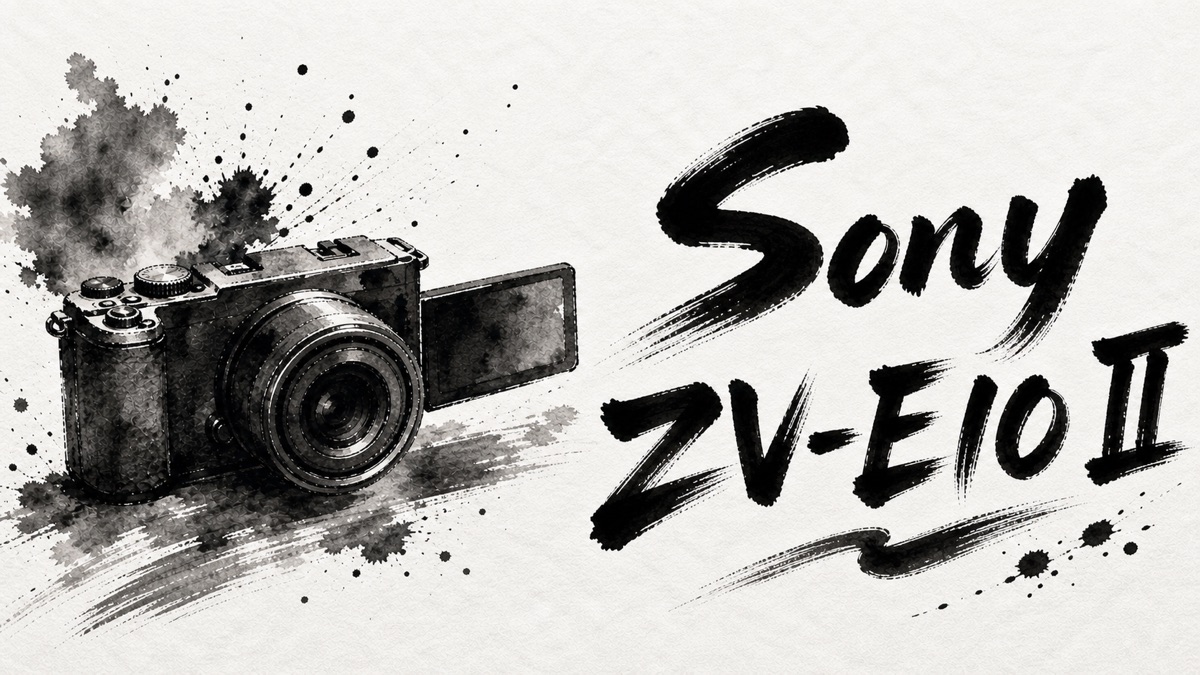
Sony ZV-E10 II is a compact APS-C mirrorless camera built mainly for video creators. It brings 4K/60p recording, 10-bit color, Sony’s modern autofocus, a lightweight body, and interchangeable lenses into a camera that is meant to be easier to carry than many traditional mirrorless bodies.
Japanese user feedback tends to focus on the appeal of a light video-first camera and the compromises that come with keeping it small and creator-focused.
Amazon.com
Sony ZV-E10 II
Check current availability on Amazon.com
As an Amazon Associate I earn from qualifying purchases.
What’s Sony ZV-E10 II
Sony ZV-E10 II, also known as ZV-E10M2 in Japan, is the second-generation APS-C interchangeable-lens camera in Sony’s VLOGCAM line. It is aimed at vloggers, YouTube creators, travelers, small-business content makers, and hybrid users who want better image quality than a smartphone without carrying a large camera system.
Compared with the original ZV-E10, the newer model brings stronger video specifications, better touch operation, a larger battery, and improved creator-oriented features. Those points matter because Japanese feedback often treats the camera as a step up from smartphones and older creator cameras.
In actual use, it is not treated only as a “vlog camera.” It also shows up as a travel camera, family camera, work camera, or lightweight sub-camera next to a larger Sony body. The design choices are clear: no viewfinder, no in-body stabilization, and fewer direct controls, but a compact body with strong autofocus, interchangeable lenses, and serious video tools.
Positive Reviews
The praise is concentrated around video quality, autofocus, portability, and the feeling that the camera is approachable without being too basic.
- Video quality is one of the strongest positive themes. Users often feel the ZV-E10 II gives them a clear step up from smartphone footage.
- 4K video, 10-bit recording, and creator-focused modes make the camera feel more serious than a basic beginner camera.
- Autofocus is repeatedly praised as fast, reliable, and beginner-friendly.
- Several users say they can get good results in auto or semi-auto shooting without deep camera knowledge.
- The lightweight body makes it easy to carry for travel, work, events, and family use.
- Many users like that the camera can shoot both video and still photos well enough for daily use.
- Some buyers use it as a compact sub-camera next to a full-frame Sony body.
- The larger battery is appreciated, especially by people who record video or already own compatible Sony batteries.
- The updated UI and touch operation are seen as easier than older Sony camera interfaces.
- Smartphone transfer and social-posting workflows are valued by users who share quickly.
- Product-focused shooting, background blur, and lens changes make it attractive for creators moving beyond a phone.
- Users who choose it for Vlog, travel, family, or light work content often feel the balance of size, image quality, and practicality is strong.
Negative Reviews
The complaints are less about image quality and more about the parts Sony left out to keep the camera small, light, and creator-oriented.
- The biggest caution is the lack of in-body image stabilization.
- Electronic Active stabilization helps, but walking video and low-light handheld footage can still show limits.
- There is no electronic viewfinder, which can be a problem for users coming from traditional cameras.
- Bright outdoor sunlight can make the rear screen harder to use.
- The vari-angle screen is useful for self-recording, but some users prefer a tilt screen for fast low-angle still photography.
- Controls are simplified, and some experienced users want more custom buttons or dials.
- The body feel and design do not satisfy everyone, especially buyers who want a more premium camera feel.
- High-quality video can require faster SD cards and extra accessories, increasing the real cost of the system.
- Battery life is improved, but video, zooming, and continuous shooting can still drain it faster than some users expect.
- As a still-photo camera, it is capable but clearly more specialized than traditional photography-focused mirrorless bodies.
Product Review Summary
Video Quality
Video is where the ZV-E10 II makes the clearest case for itself.
Pros
- The ZV-E10 II is repeatedly treated as a video-first camera, not just a small stills body.
- Users like the jump from smartphone video to cleaner 4K footage with interchangeable lenses.
- 4K/60p and 10-bit recording make the camera feel more future-proof for creators.
Cons
- Getting the most from high-quality video may require faster SD cards, more storage, and better editing workflow.
- Stabilization is not as strong as a gimbal camera or a body with IBIS.
- Beginners may need time to understand video settings and file requirements.
The ZV-E10 II is strongest when buyers actually plan to use its video features, not just treat them as a spec-sheet bonus.
Autofocus and Ease of Use
Ease of shooting is the other major thread.
Pros
- Autofocus is repeatedly described as dependable and easy to trust.
- Beginners appreciate getting sharp results without complicated setup.
- Product, people, family, and event shooting all benefit from reliable subject tracking.
Cons
- Experienced users may want more physical controls.
- Some workflows still require learning Sony menus and custom settings.
- The camera is easy for basic use, but advanced video work is not fully automatic.
The autofocus and simplified operation make the ZV-E10 II approachable, but it still rewards users who learn the system.
Portability
Portability is not just a spec here; it shapes how people use the camera.
Pros
- The light body is one of the clearest advantages in Japanese feedback.
- It works well for travel, walks, events, work bags, and as a second camera.
- Users coming from smartphones or compacts often find it easier to carry than a larger mirrorless setup.
Cons
- The light body also contributes to a less premium feel for some buyers.
- With lenses, microphones, grips, batteries, and SD cards, the system can become less minimal.
- Handling with larger lenses is not as balanced as a bigger camera body.
The ZV-E10 II is genuinely portable, but its real carry size depends on the lens and accessories chosen.
Still Photo Performance
Despite the VLOGCAM name, still photos are part of the appeal.
Pros
- Users often say still photos are better than expected for a VLOGCAM-branded product.
- Travel, family, snapshots, and casual photography are common positive use cases.
- The APS-C sensor and interchangeable lenses give more creative flexibility than a phone.
Cons
- It lacks a viewfinder and mechanical shutter.
- The vari-angle screen may be slower than a tilt screen for some still-photo situations.
- Users focused mainly on photography may prefer a more traditional body.
The ZV-E10 II can take very good photos, but its design priorities are video and creator workflows.
Stabilization and Handheld Use
Stabilization is where the camera’s video-first identity meets its biggest limitation.
Pros
- Active electronic stabilization is useful for casual video.
- For standing shots, product shots, and light handheld shooting, many users find it good enough.
- The light body makes it easy to pair with a grip or gimbal if needed.
Cons
- There is no in-body image stabilization.
- Walking video can still look less stable than some users expect.
- Low-light handheld shooting can expose the limits of electronic stabilization.
Stabilization is usable, but it is one of the main areas where expectations need to be managed.
Battery and Workflow
Battery life and workflow matter because this is the kind of camera people carry for long days.
Pros
- The NP-FZ100 battery is a meaningful upgrade.
- Users who already own Sony cameras appreciate battery sharing.
- Video users and travel users see the larger battery as a practical advantage.
Cons
- Video recording, power zoom use, and wireless workflows can still drain the battery quickly.
- Serious users may still want a spare battery or USB-C power plan.
- High-quality video also creates larger files and accessory needs.
Battery life is a strength compared with smaller creator cameras, but it does not remove the need to plan for longer shoots.
Screen, Controls, and Body Feel
Handling is the area where the ZV-E10 II feels most different from a traditional enthusiast camera.
Pros
- The vari-angle screen is useful for self-recording and flexible framing.
- Touch operation and the updated interface are easier than older Sony designs.
- The simplified body is friendly for users moving up from smartphones or compact cameras.
Cons
- The rear screen can be difficult in bright sun.
- Some users prefer a tilt screen for fast still-photo shooting.
- The body can feel more practical than premium, and control options are limited.
The ZV-E10 II is designed around creator convenience, not old-school camera tactility.
Value
Value depends heavily on whether the buyer actually wants a light creator camera.
Pros
- Strong value for creators who want 4K video, Sony AF, interchangeable lenses, and light weight together.
- It is appealing as a first serious camera, a travel camera, or a Sony sub-camera.
- Users who shoot both video and photos get more flexibility than with a fixed-lens compact or action camera.
Cons
- Extra lenses, SD cards, batteries, microphones, or stabilization gear can raise the total cost.
- It is less convincing if someone mainly wants a stills camera.
- Buyers who need IBIS, EVF, and more controls may outgrow it quickly.
The ZV-E10 II offers strong value when its video-first design matches the buyer’s real shooting style.
Amazon.com
Sony ZV-E10 II
Check current availability on Amazon.com
As an Amazon Associate I earn from qualifying purchases.
Summary
Sony ZV-E10 II comes across as a compact creator camera first and a traditional stills camera second. It fits buyers who want better video and better photos than a smartphone, without committing to a heavy camera bag.
Its best points are video quality, autofocus, portability, battery improvement, easy operation, smartphone-to-camera upgrade value, and enough still-photo quality for travel and family use. Its weak points are lack of IBIS, no viewfinder, simplified controls, bright-screen limitations, accessory costs, and a body feel that may not satisfy traditional camera lovers.
It is recommended for:
- Vloggers and YouTube creators who want an interchangeable-lens camera.
- Smartphone users moving to a serious camera for the first time.
- Travelers who want light video and photo gear.
- Families who want better child, event, and travel footage.
- Sony users who want a compact second camera.
It may not be the best choice for:
- Buyers whose main priority is still photography.
- Users who need in-body image stabilization.
- People who strongly prefer a viewfinder.
- Shooters who want many buttons, dials, and custom controls.
- Buyers who want the simplest possible all-in-one camera with no accessories.
Put simply, the ZV-E10 II makes the most sense when its compromises are part of the point: no viewfinder, no IBIS, fewer controls, but a light body with strong AF, flexible lenses, and serious video tools. For creators, travelers, and smartphone-upgraders, that trade-off can be exactly right.
Comments