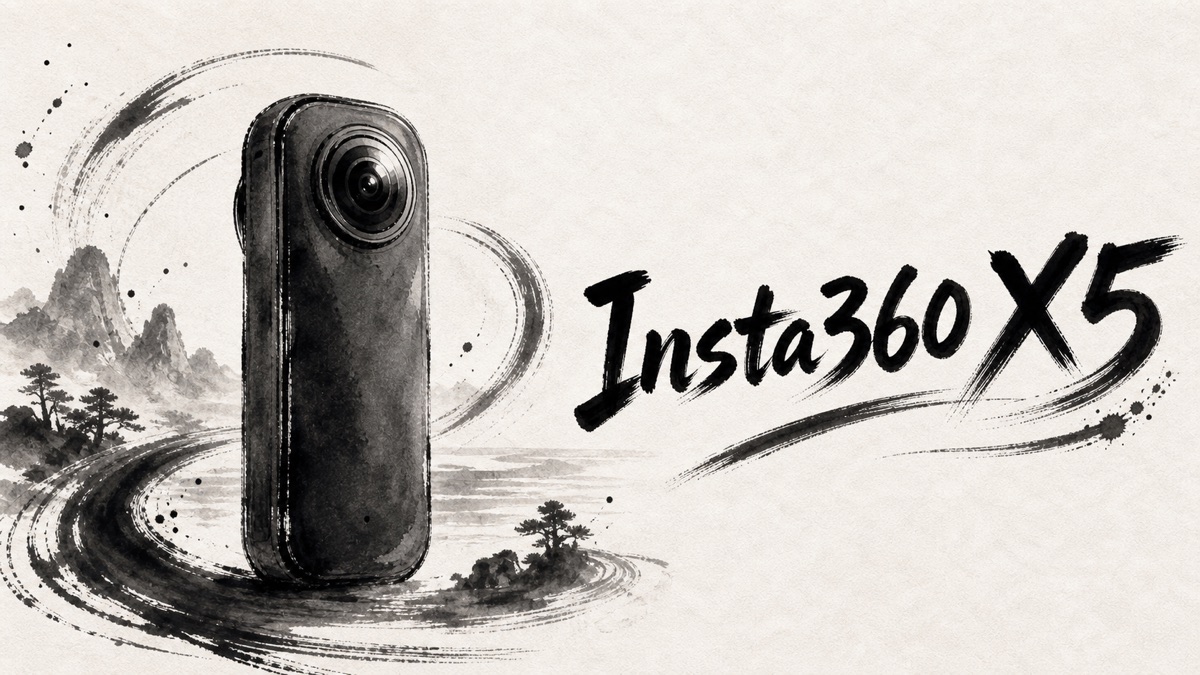
You may be considering the Insta360 X5 because you want something different from a regular action camera: a compact 360 camera that can record everything around you first, then let you choose the best angle later.
Japanese user feedback suggests that the X5 is being judged mostly as a travel, sports, motorcycle, event, and creator camera. Users like the idea of capturing moments without aiming perfectly, then reframing the footage afterward for social clips, memories, or work.
At the same time, the same feedback also makes the trade-offs clear. 360 video is not just shooting; it also means editing. Accessories can add bulk, total cost can rise, the body can get warm, and distant subjects are not its strength.
Amazon.com
Insta360 X5
Check current availability on Amazon.com
As an Amazon Associate I earn from qualifying purchases.
What’s Insta360 X5
Insta360 X5 is an 8K 360-degree action camera. Unlike a standard action camera that records mainly what is in front of it, the X5 records a full spherical view, so users can reframe shots after recording.
Insta360 positions the X5 around high-resolution 360 video, improved low-light shooting, replaceable lenses, stabilization, and tools for quickly turning 360 footage into shareable flat clips. Japanese feedback often connects those official strengths with travel, sports, motorcycles, events, and memories where it is useful to record the whole scene first.
The key question is not only whether the specifications are strong. Users are asking whether the X5 makes travel and action shooting easier, whether the footage is worth the editing work, and whether it is a better fit than a simpler action camera.
Positive Reviews
Positive feedback usually comes from users who want the creative flexibility of 360 capture, not just a normal forward-facing action camera.
- Image quality is one of the strongest positive themes. Users often mention cleaner footage, better detail, and a visible improvement over older 360 cameras.
- Low-light performance is a major upgrade point. Japanese feedback includes indoor, night, and darker-scene use as reasons the X5 feels more capable.
- 360 capture is genuinely useful for memories. Users like being able to record a whole scene and decide the framing afterward.
- Travel and event use are a natural fit. The camera is often discussed as a way to capture trips, festivals, walking scenes, and places where the user may not know the best angle in advance.
- It suits sports and motorcycle use. Visible feedback includes action, riding, and movement-heavy situations where multiple viewpoints are useful.
- X4 upgraders notice improvements. Image quality, responsiveness, menu operation, battery life, and handling are recurring upgrade points.
- Replaceable lenses are appreciated. Users see value in shooting without relying as heavily on lens guards and in having a repair path if glass is damaged.
- Battery life receives positive comments from some users. It is not unlimited, but several impressions treat it as better than older expectations.
- Audio quality is better than some users expected. Visible feedback includes praise for built-in sound and clearer voice capture.
- The camera can replace a larger set of devices for some users. People with multiple action-camera or gimbal setups may see the X5 as a flexible single tool.
- Beginner bundles can be convenient. Kits with batteries, selfie sticks, lens caps, and cases can help new users start without choosing every part separately.
- The editing process can be fun. Even when users say editing is hard, some also describe the creative control as part of the appeal.
Negative Reviews
Critical feedback focuses on the extra work and accessories that come with a 360 camera workflow.
- Editing is the clearest learning curve. Shooting is easy, but choosing angles, reframing, exporting, and managing files can take practice.
- It is not ideal for distant subjects. Cropping 360 footage is not the same as optical zoom, so stage, far-away scenery, or narrow framing can disappoint.
- Accessories can add bulk. The camera body is compact, but selfie sticks, batteries, mounts, and cases change the real carry size.
- The total kit can become expensive. Some users are sensitive to the cost of the camera, protection plans, cloud services, and accessories.
- Full bundles are not always the best value. Beginners may appreciate them, but experienced users may prefer buying only the parts they need.
- Heat can matter. Some feedback points to the body getting warm, especially when thinking about summer or long recording sessions.
- Old accessories may not all carry over. X4 owners should check battery and accessory compatibility before assuming a simple upgrade path.
- Software friction can reduce satisfaction. Some users dislike extra setup, logos, cloud prompts, or service suggestions.
- It is not the same as a normal action camera. Buyers who only want a simple forward-facing clip may find a GoPro-style camera easier.
- High-resolution 360 video needs storage and processing time. The workflow can be heavier than phone or standard action-camera clips.
Product Review Summary
Image Quality
Image quality is one of the main reasons Japanese users treat the X5 as a meaningful upgrade over older 360 cameras.
Pros
- Japanese users often describe the X5 as cleaner and more detailed than older 360 cameras.
- Low-light and indoor performance are meaningful upgrade points.
- X4 users in particular often notice improvements in image quality and response.
Cons
- 360 footage still has limits when heavily cropped.
- Distant subjects can look small or soft compared with optical-zoom cameras.
- Users who want the best possible flat video may still prefer a dedicated camera.
The X5 appears strongest when the buyer values 360 flexibility more than traditional zoom or lens control.
360 Capture & Reframing
Reframing is the core reason to buy this kind of camera, but it also creates work after the shoot.
Pros
- Recording everything first reduces the pressure to aim perfectly.
- Users can revisit trips, events, and rides from different angles later.
- It is useful when the camera operator also wants to appear in the memory.
Cons
- Reframing creates extra work after shooting.
- The best results require learning the app or desktop workflow.
- People who dislike editing may not enjoy the full value of a 360 camera.
The X5 is most appealing when the buyer enjoys the idea of shaping footage after the moment has passed.
Travel, Sports & Motorcycle Use
Travel, sports, motorcycles, and events are where the X5’s all-around capture style feels most natural.
Pros
- Japanese feedback naturally connects the X5 with travel, sports, motorcycles, events, and everyday movement.
- Stabilization and 360 capture make it easier to produce dynamic clips.
- The camera can capture both the subject and the user without constant repositioning.
Cons
- Mounted use may require extra accessories.
- Heat, battery planning, and file management matter for long sessions.
- Audio and mounting choices can affect the final result.
For movement-heavy shooting, the X5 can be more flexible than a normal action camera, but it also asks for a more planned setup.
Editing & App Workflow
The ownership experience continues after recording because 360 footage usually needs app or desktop work before it becomes a finished clip.
Pros
- The app and auto-editing features can make 360 footage easier to share.
- InstaFrame can help users get a quick flat clip while keeping a 360 file for later.
- Creative control is a major part of the product’s appeal.
Cons
- Editing is repeatedly mentioned as difficult or time-consuming.
- Some users dislike software prompts, logos, or cloud-related friction.
- Larger files can make phone and desktop workflows feel heavier.
The X5 is not just a camera purchase. It is also a commitment to a 360 editing workflow.
Accessories & Durability
Accessories can make the X5 far more useful, but they also change the real size and cost of the kit.
Pros
- Replaceable lenses reduce anxiety around one of the most vulnerable parts of a 360 camera.
- Extra batteries, selfie sticks, and mounts can make the system much more useful.
- Beginner bundles can remove some setup uncertainty.
Cons
- Accessories increase bulk and total cost.
- Some users may buy more kit than they actually need.
- X4 accessory compatibility should be checked carefully.
The accessory ecosystem is a strength, but buyers should match it to a real use case instead of assuming every bundle is necessary.
Value
Value depends on whether the buyer will really use 360 capture and editing rather than treating the X5 like a normal action camera.
Pros
- Strong fit for users who specifically want 360 capture, reframing, and action footage.
- Good choice for travel, events, motorcycles, sports, and creators who like post-production flexibility.
- Japanese user satisfaction looks broadly positive in the checked reviews.
Cons
- The value is weaker for users who only need simple forward-facing video.
- Total cost can rise with accessories, storage, protection, and services.
- Existing X4 users should compare the improvements against their own workflow.
The X5’s value is strongest when the buyer will actually use 360 capture and editing, not simply treat it as a regular action camera.
Amazon.com
Insta360 X5
Check current availability on Amazon.com
As an Amazon Associate I earn from qualifying purchases.
Summary
Insta360 X5 suits users who want a compact 360 camera for travel, sports, motorcycles, events, family memories, and creator-style clips. Japanese user feedback is especially positive around image quality, low-light improvement, 360 capture, X4 upgrade value, replaceable lenses, battery improvements, and the creative freedom of reframing footage later.
It is recommended for:
- Travelers who want to capture whole scenes without aiming perfectly.
- Sports and motorcycle users who want multiple viewpoints from one camera.
- Creators who enjoy editing and reframing footage after recording.
- X4 users who want better image quality, responsiveness, battery, and lens flexibility.
- Beginners who want a kit-based entry into 360 shooting.
It may not be the best choice for:
- Buyers who dislike editing or file management.
- Users who mainly shoot distant subjects or need optical zoom.
- People who only want simple forward-facing action clips.
- Existing X4 owners who rely on older batteries or accessories.
- Buyers who want the lowest possible total kit cost.
The X5 works best for users who enjoy shaping footage after recording. Its appeal is clear: better-looking 360 footage, useful low-light improvements, flexible reframing, replaceable lenses, and strong travel/action versatility. Its cautions are equally practical: editing effort, heat, accessories, total cost, storage, and the fact that 360 video rewards users who enjoy shaping the final clip after recording.

Comments