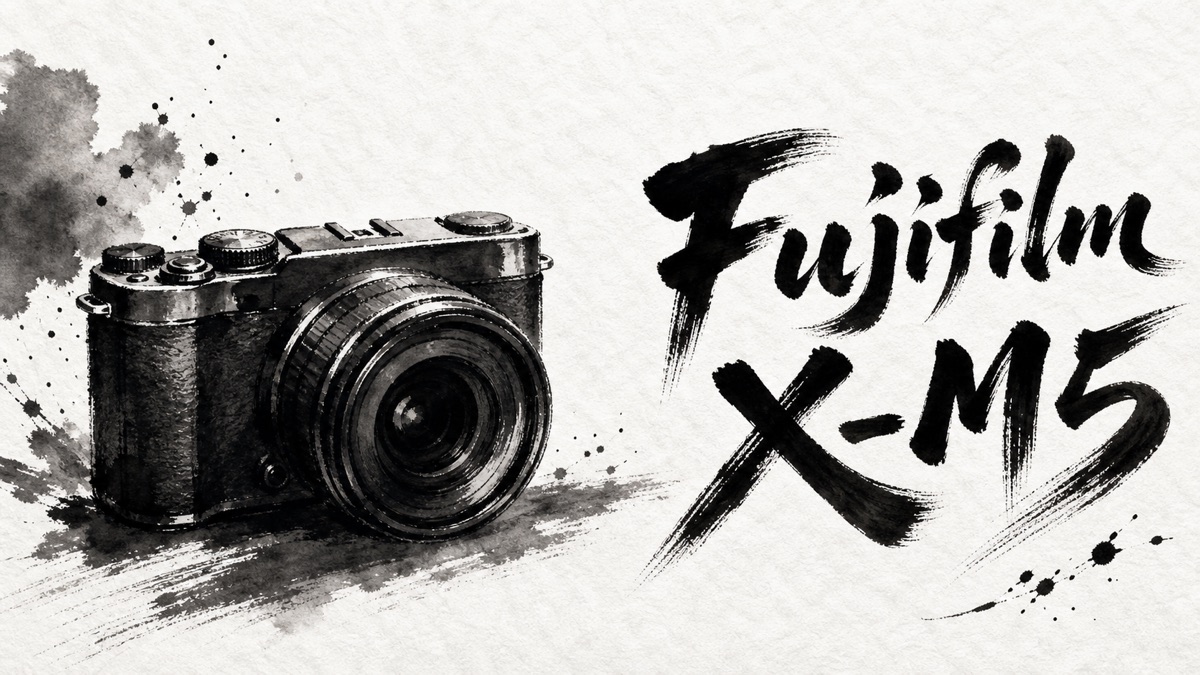
Fujifilm X-M5 is easy to understand on paper: a tiny APS-C mirrorless camera with Fujifilm color, interchangeable lenses, and creator-friendly video features. The more interesting question is whether that small body makes everyday photography more enjoyable, or whether it removes too many of the controls and comforts that camera users usually expect.
Visible Japanese user feedback gives a fairly consistent answer. Many owners like the X-M5 because it feels close to a premium compact camera when paired with a small lens. It is praised as a camera for walks, travel, street snapshots, cafe photos, pets, and casual everyday use. Film simulations are not a minor extra in these comments; they are one of the reasons people want to pick the camera up.
The same feedback also makes the compromises easy to see. The lack of an electronic viewfinder is the largest dividing point. Handling, battery confidence, lens choice, and the absence of in-body stabilization all shape whether the X-M5 feels charming or too stripped down. This article does not treat the X-M5 as a lab-tested camera. It looks at patterns in Japanese user impressions to understand who this small Fujifilm body appears to satisfy, and who may want something more traditional.
Amazon.com
Fujifilm X-M5
Check current availability on Amazon.com
As an Amazon Associate I earn from qualifying purchases.
What’s Fujifilm X-M5
Fujifilm X-M5 is a compact mirrorless camera in the X Series. It uses Fujifilm’s X-mount, which means buyers are choosing not only a small body but also a lens system. That matters because Japanese feedback often treats the X-M5 as a camera whose appeal depends on keeping the whole kit light.
Fujifilm positions the camera around a small body, film simulations, interchangeable lenses, autofocus, and creator-friendly video features. The dedicated film simulation dial is especially relevant to user comments because many buyers are not just asking for technical image quality. They want a camera that makes Fujifilm color easy to enjoy without turning every photo into a computer-editing project.
The main compromise is just as central. The X-M5 does not have a built-in electronic viewfinder or in-body image stabilization. That design helps keep the camera small and approachable, but it also explains many of the negative comments about screen-only shooting, grip comfort, handheld video, and whether the camera can replace a larger Fujifilm body.
Positive Reviews
The strongest positive comments tend to come from people who know why they want a very small Fujifilm camera.
- Portability is the clearest strength. Users often describe the X-M5 as a camera they can keep in a bag for short walks, travel, and daily use.
- The body works well as a snapshot camera. Japanese impressions often place it in ordinary scenes rather than demanding professional shoots.
- Film simulations are a major source of enjoyment. Users like being able to get a satisfying color look without turning every photo into an editing project.
- APS-C image quality in a small body is appreciated. Several comments treat the X-M5 as a meaningful step beyond phone snapshots or tiny-sensor compacts.
- The design receives positive attention. Buyers respond to the look, the size, and the top-plate film simulation dial.
- The camera pairs well with compact lenses. Small primes and lightweight zooms help the X-M5 feel like the product it is meant to be.
- The kit zoom is useful for some users. It is often treated as a practical travel or city-walk lens, especially because it keeps the kit light.
- It can be a good everyday second body. Existing Fujifilm users may enjoy having a lighter camera when they do not want to carry a larger system.
- Travel use is a natural fit. Feedback links the camera with trips, city walks, cafes, and casual outings where size matters.
- Some users find the interface approachable. The X-M5 does not feel like a control-heavy camera, and that can be positive for casual shooting.
- Touch operation is useful in everyday scenes. Pet, family, and quick-snapshot comments suggest that the rear screen can be practical when the shooting style fits.
- The camera makes people want to carry a real camera more often. That emotional point appears repeatedly: the X-M5 is praised when it lowers the barrier to bringing a camera along.
Negative Reviews
The critical comments are not random. They mostly come from the same design choice that makes the X-M5 so small.
- The lack of an electronic viewfinder is the biggest concern. For some users, this is the difference between a fun compact camera and a camera that feels incomplete.
- Bright outdoor scenes can be harder. When the rear screen is difficult to see, a viewfinder would be useful.
- Manual focusing can feel less comfortable. Screen-only shooting is not ideal for everyone, especially in backlight or careful composition.
- Physical controls are limited. Compared with larger Fujifilm bodies, the X-M5 has fewer direct buttons and dials.
- Grip is not a strong point. The small body is easy to carry, but it can feel less secure in the hand.
- Some users may need a case or grip. That can improve handling, but it also changes the clean, compact setup.
- Battery confidence is not a standout theme. Feedback suggests that some owners think about spare batteries for longer outings.
- No IBIS should shape video expectations. The X-M5 can record high-quality video, but handheld shooting is not the same as using a stabilized body.
- Lens choice can become restrictive. Large lenses work, but they reduce the reason to buy such a compact camera.
- The power zoom kit lens may divide opinion. It is compact and useful, but users who prefer mechanical zoom rings may not enjoy its feel.
- It is not a direct replacement for a larger enthusiast camera. Buyers who want an EVF, strong grip, and more controls may prefer another Fujifilm body.
- Some buyers may outgrow the compromises. The X-M5 can be charming as a daily camera, but less satisfying as an only camera for all serious stills and video work.
Product Review Summary
Portability & Everyday Carry
The X-M5 makes the most sense when the buyer wants a camera that comes along without much planning. Japanese feedback repeatedly frames it as a walking, travel, city, and daily-life camera.
Pros
- The body is small and light for an APS-C interchangeable-lens camera.
- Users are more likely to bring it on ordinary outings.
- It works well as a casual second body for existing Fujifilm owners.
Cons
- The portability advantage depends heavily on lens choice.
- A small body also means less grip area and fewer physical controls.
- Adding a case, grip, microphone, or larger lens can quickly change the carry experience.
The X-M5 is strongest when it stays small. Buyers planning to use large lenses most of the time may lose the main reason this camera exists.
Fujifilm Color & Image Quality
The emotional pull of the X-M5 comes from Fujifilm color in a camera that feels easy to pick up. Users do not discuss it only as a specification sheet; they talk about enjoying the look of their images.
Pros
- Film simulations are a repeated reason for choosing the camera.
- APS-C image quality gives casual photos more depth than many phone or compact-camera shots.
- The dedicated simulation dial reinforces the feeling that color is part of the shooting process.
Cons
- Image satisfaction still depends on the lens and shooting situation.
- Buyers expecting full-frame rendering or heavy cropping flexibility may want a different system.
- A higher-end Fujifilm body may be better for demanding still photography.
The X-M5 is appealing when the user wants pleasing Fujifilm JPEGs and casual creative control, not when they expect the smallest body to behave like a flagship.
EVF, Screen & Handling
The screen-only design is the part of the X-M5 that buyers should think about most carefully. It is not a small X-T body; it is a different shooting posture.
Pros
- Removing the viewfinder helps keep the camera compact.
- Screen-based shooting fits casual use, selfies, video, and phone-like framing.
- Touch operation can be convenient for quick everyday photos.
Cons
- Bright outdoor light and backlit scenes can make screen-only shooting harder.
- Manual focus and careful framing are less comfortable without an EVF.
- Users coming from traditional cameras may miss more buttons, dials, and a deeper grip.
This is the main fork in the road. If a viewfinder feels essential, the X-M5’s charm may not outweigh the compromise.
Video & Creator Use
Fujifilm clearly gave the X-M5 more video capability than its size suggests. The feature list is strong for casual creators, but user expectations need to stay realistic.
Pros
- Official features include 6.2K/30p 10-bit recording, 4K/60p, three microphones, Short Movie mode, and creator-oriented interface tools.
- The small body is easy to bring for casual video and social clips.
- Film simulations can help video look more finished straight from the camera.
Cons
- No in-body stabilization is important for handheld video.
- Serious video users may still need a grip, external audio, support, or cooling accessories.
- Some stills-first buyers may not use the creator-focused features enough to justify them.
The X-M5 is better understood as a small hybrid camera for casual creators than as a stabilized video workhorse.
Lens Choice & System Fit
Because the X-M5 is an interchangeable-lens camera, the lens can either support or undermine the whole idea. Japanese feedback makes this point more clearly than the specification list does.
Pros
- Compact primes can make the X-M5 feel close to a premium compact camera.
- Lightweight zooms keep it useful for travel and city shooting.
- Existing X-mount users can treat it as a small companion body.
Cons
- Large lenses make the body feel less balanced and less pocketable.
- The compact kit zoom is useful, but its power-zoom behavior may not suit everyone.
- New Fujifilm buyers should think about the full lens kit, not just the body.
The X-M5 rewards buyers who plan the lens around the body. It is less convincing if the kit grows into something that should have been a larger camera.
Value & Upgrade Decision
The X-M5 is attractive because it gives buyers Fujifilm color, APS-C image quality, and lens flexibility in a small body. Its value depends on whether the buyer accepts the missing parts.
Pros
- It can be a satisfying everyday Fujifilm camera.
- It offers more system flexibility than a fixed-lens compact.
- It suits buyers who want portability more than maximum control density.
Cons
- Fujifilm models with EVF, IBIS, or larger grips may be better for serious all-purpose use.
- Accessories can add cost and bulk if the buyer tries to solve every compromise.
- Users who want one camera for everything may find the X-M5 too specialized.
The X-M5 is a good fit when small size is the goal, not a problem to be corrected afterward.
Amazon.com
Fujifilm X-M5
Check current availability on Amazon.com
As an Amazon Associate I earn from qualifying purchases.
Summary
Japanese user feedback presents the Fujifilm X-M5 as a small camera with a very clear personality. It is praised when it is used as an everyday Fujifilm body: light, enjoyable, color-focused, and easy to bring along. It becomes more questionable when buyers expect a traditional camera experience with a viewfinder, stronger grip, heavier controls, and built-in stabilization.
It is recommended for:
- Fujifilm color fans who want a small everyday camera.
- Travelers, walkers, and city photographers using compact lenses.
- Existing X-mount users who want a lighter second body.
- Buyers who are comfortable composing on the rear screen.
- Casual creators who want video features in a very portable camera.
It may not be the best choice for:
- Users who need an electronic viewfinder.
- Photographers who rely on in-body stabilization.
- Buyers who prefer many physical controls and a deeper grip.
- People planning to use large lenses most of the time.
- Users who want one camera to cover every serious stills and video situation.
The X-M5 is not trying to be the most complete Fujifilm body. It is trying to be the one you actually take with you. For the right buyer, that may be the most important feature.


Comments